
This online meetup brings together researchers and technology developers with experienced entrepreneurs and leaders looking to join a research team as a business co-founder. It’s for you if you have business experience and the ambition to build something big, but don’t yet have a technical team or a scientific idea to build a company around.
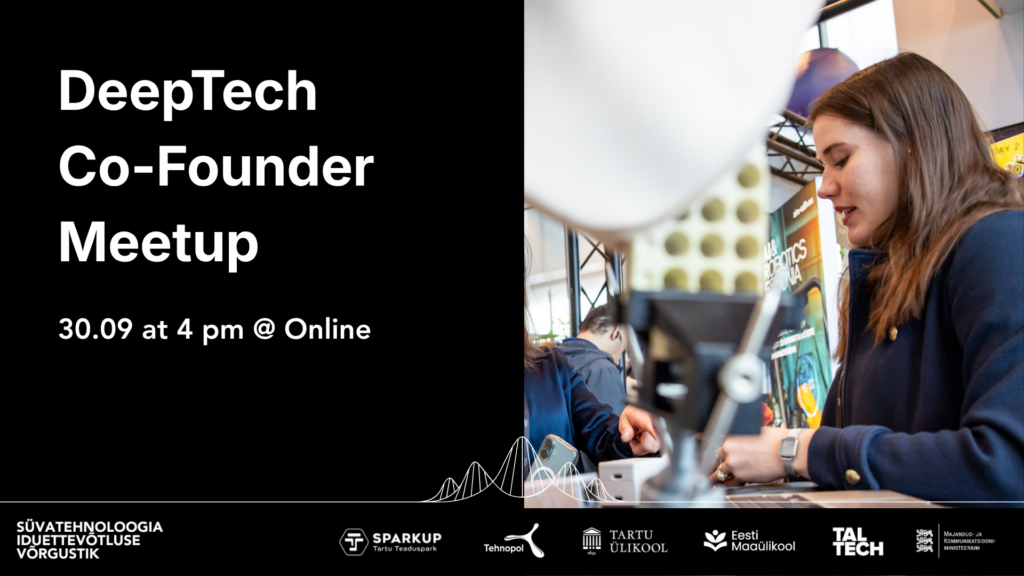
You’ll hear short pitches from research projects currently looking for a business co-founder. You can meet the teams, ask questions, and find the people you could build the next deep tech success story with.
If you have business-side skills and the drive to build something big, come meet the ideas and teams currently looking for a co-founder.
More details about the participants will be added soon. Keep an eye on this page.
Did you know? Deep tech makes up just 12% of Estonia’s startup sector, yet attracts half of all its investment. (Source: Startup Estonia)
Featuring Andi Hektor

Andi Hektor is a physicist and entrepreneur who has moved between science and business throughout his career. He holds a PhD in particle and astrophysics and has founded and led several research-intensive companies over the years.
Andi is a well-known advocate for science- and technology-driven deep tech entrepreneurship, and speaks publicly about the need for closer collaboration between researchers, entrepreneurs, and investors. At the meetup, he’ll share his own experience of the journey from researcher to entrepreneur.
Moderated by Anastasiia Shevchenko
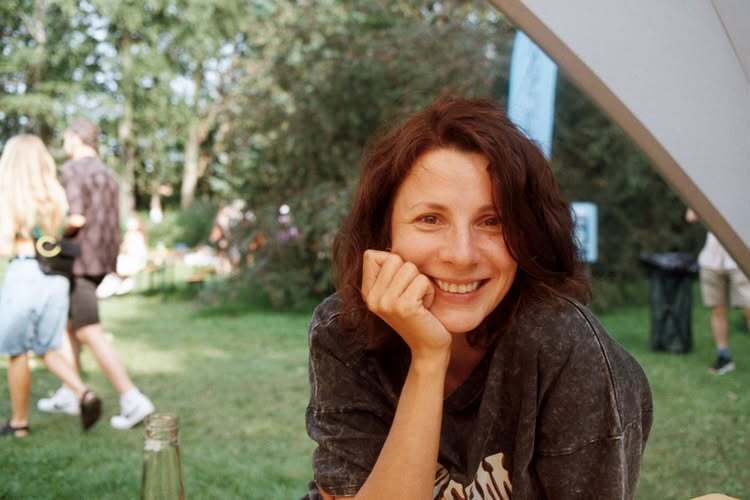
Anastasiia Shevchenko moderates the event. Anastasiia works across strategy, product, and venture building, typically in 0→1 and transformation settings. Her background spans science-to-business, product leadership, strategy, and product portfolio development across education, manufacturing, and sustainability. Today she runs 0.93, helping organizations rethink strategy, identify new opportunities and turn them into tangible initiatives and products.
Which teams will be pitching their ideas?
MycoHero: circular bioeconomy/textile
Our team is investigating ways to repurpose used textiles using mycelium. We are developing solutions that bind textile waste with mycelium to transform it into new, eco-friendly biomaterials.
The team brings together expertise in mycology, materials science, and design. Maidu Silm, Chief Specialist in Hydrobiology at the Estonian University of Life Sciences, works in the field of mycology. Ants Herodes, a Hydrobiology Specialist at the Estonian University of Life Sciences, brings a background in design and experience researching textile circularity. The team’s strength lies in identifying connections between different fields and creating practical solutions that bridge biology, material properties, and design.
Dirk Oliver: EdTech
The team is developing an ed-tech solution that teaches middle school students the basics of quantum information. The solution combines a playful, hands-on, and almost math-free approach and consists of physical teaching aids designed for group work, along with accompanying teaching materials.
Team: Dirk Oliver, Associate Professor and PhD (Mathematics) at the University of Tartu.
Kinora: AI
Relationships often deteriorate gradually through stress, misunderstandings, and repeated unresolved conflict. Existing apps are mostly passive journals or conversation prompts that depend on people already recognising the problem, ignoring valuable signals from voice, behaviour, sleep, and physiological stress.
Kinora is a proactive AI coach for couples. Each partner can record short voice reflections, which the system transcribes and analyses for changes in language and vocal patterns, combining these, with permission, with sleep, heart rate, and activity data. The AI maintains separate private models for each person alongside a shared relationship model, recommending timely actions, such as taking a pause, asking for support, or repairing a conversation, before tension turns into a crisis. Privacy, consent, and human control are built into the product from the start.
The team includes Armando Vieira, Lecturer in Applied Artificial Intelligence at the University of Tartu and PhD (Physics), with more than 25 years of experience in artificial intelligence. He has co-founded Medgical.ai, among other ventures, and serves on the ISO AI Committee.
MEJS: industrial robotics / energy efficiency
As industrial robots become more widely used, the need to improve their energy efficiency grows, but current control systems don’t provide detailed enough data on which drive, motion, or operation drives energy consumption.
The team is developing a modular multi-phase electrical energy monitoring system (MEJS) that measures electrical signals directly from the robot manipulator’s motor phases, independent of the manufacturer’s control system, and synchronizes them with the robot’s operational data. This creates a structured dataset that lays the groundwork for AI-based energy analysis and more efficient control strategies.
The team includes Anton Rassõlkin, Tallinn University of Technology Professor and Project Lead, Johannes Muru, Tallinn University of Technology PhD student and industrial robotics expert, and Taavi Salum, Tallinn University of Technology PhD student and electrical engineering/measurement systems expert.
COL-TECH: maritime surveillance / defense technology
COL-TECH is a TalTech-led IT development project to improve maritime situational awareness. The team is developing new algorithms that can manage complex situations where autonomous systems and crewed vessels operate together at sea, enabling risk assessment and threat prevention for both underwater infrastructure (cables, pipelines) and surface assets.
The resulting technology lays the groundwork for new commercial services in Estonia’s IT sector; licensable algorithms and standardized interfaces will let companies build safety-analysis tools and decision-support systems, strengthening Estonia’s defense and maritime IT exports and boosting national security through better critical-infrastructure protection.
The team includes seven researchers from TalTech’s Software Science Institute and Cybernetica: Riina Palu, Jüri Vain, Jaanus Kaugerand, Gert Kanter, Paula Etti, Edvard Kallas ja Hiba Ben Lahbib.