
Datifex is building a real-time command layer* for defence and critical infrastructure operations. Its platform, DATIVerse 3D™, delivers a browser-based 3D environment where operators can monitor and control complex systems using live operational data, digital twins** and AI within a single interface.
As defence and critical infrastructure systems become more complex, operators must interpret large volumes of real-time data while coordinating decisions across multiple systems. In many cases, those systems remain fragmented, forcing teams to work across dashboards, simulations and disconnected tools. Datifex addresses this challenge by providing a unified operational environment that brings data and action together.
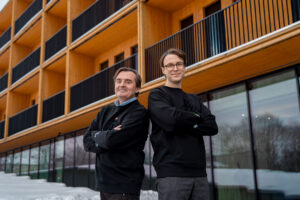
Chris Erickson (on the left), founder and chief executive officer of Datifex, leads the company with a background spanning engineering, law and technology entrepreneurship. Earlier in his career he co-founded 724 Solutions, an early mobile banking pioneer whose technology enabled banking on mobile phones before the smartphone era. The company later completed an IPO and reached a market capitalisation in the billions.
Datifex is also one of the 12 companies currently participating in the 2026 batch of the NATO DIANA Estonian Accelerator.
How was the startup idea born?
The idea behind Datifex began with a simple observation. Large volumes of operational data were becoming increasingly difficult to interpret and act on. Early experiments explored film-style visual effects approaches to represent complex data sets. While visually impressive, those systems required specialised artists, took hours to render and offered little opportunity for real interaction.
The breakthrough came with game-engine technology***. Rendering operational data inside an interactive environment and delivering it through a browser made it possible for users to interact with live systems in real time without installing specialised software. It also revealed a broader opportunity to integrate data from fragmented legacy systems**** into a single operational environment.
Early work with systems integrators, including Capgemini, led to our first major engagement with GE Transportation and BNSF Railway in the United States. The platform enabled operators to manage intermodal railway terminals in real-time in a 3D environment.
The project confirmed an important insight. Operators think spatially, and visualising operations in this way makes complex systems easier to understand and manage collaboratively.
That work raised our profile within the Canadian government. We were later engaged by the Royal Canadian Navy for dockyard management, ship maintenance, training systems and digital twins, and we are now also engaged with the Canadian Army.
We have also supported projects with the Canada Border Services Agency and the National Research Council, with additional development supported through Innovation Solutions Canada.
Who is behind Datifex?
Datifex was founded in 2014 by experienced technology entrepreneurs and engineers who had previously built and scaled enterprise software platforms. Today we have about fifteen staff across Halifax, Toronto and Chennai.
I lead the company alongside chief technology officer Raj Thulasidoss and vice president of operations Diane Broeders. Diane and I first met while studying engineering at the University of Waterloo. Raj later joined as technical co-founder when we were assembling the team to support a major infrastructure project.
Raj now leads development of the DATIVerse 3D platform and oversees our engineering team in India. Diane, a professional engineer with an MBA, brings operational and infrastructure experience from both public and private sectors.
Our broader team also includes Corey Kirkhus, director of business development and product, recently recognised by Canadian Defence Review as one of Canada’s top aerospace and defence professionals under 40, and Joanne Niblock, a sales leader with more than three decades of enterprise technology experience.
What problem does the technology solve?
Modern defence and critical infrastructure operations generate vast volumes of real-time data, yet many organisations still rely on fragmented dashboards and siloed systems that show information but do not allow operators to act directly on it.
This fragmentation slows decision-making and increases dependence on specialised experts who must interpret information across multiple systems.
DATIVerse 3D addresses this challenge by providing a unified command, control and intelligence environment. Through a browser-based 3D interface, operators can interact with live operational systems, digital twins and AI-supported insights within a single operational layer.
Because the platform runs directly in a browser, there is no software installation or specialised hardware required, and it can be accessed securely from anywhere. The system has been validated with the Royal Canadian Navy, NATO DIANA and in civilian environments including ports, railroads and border operations.
What has been the biggest challenge so far?
One of our main challenges has been the pace of sales cycles and contracting processes within defence organisations and large infrastructure operators.
Technology used in mission-critical environments must meet extremely high reliability and security standards. Defence and infrastructure operators have little tolerance for downtime, inaccuracies or vulnerabilities. Any new operational layer must therefore demonstrate resilience as well as technical capability.
Integration with legacy systems has also been complex. Many organisations continue to operate decades-old applications alongside modern platforms, with operational data spread across tools that were never designed to interoperate.
Our focus has been on building an architecture capable of securely connecting these systems without disrupting daily operations.
What has been the biggest win so far?
One of our most important milestones has been securing a growing set of contracts with Canada’s Department of National Defence. The platform has been applied in operational areas including naval vessel maintenance, harbour operations, officer-of-the-day management*6 and training systems.
Being selected as a NATO DIANA innovator marked another significant step. It confirmed that our work aligns with NATO priorities around resilience, readiness and data-assisted decision-making.
Equally important has been the transition from pilot projects to operational deployments. The platform is now running in live defence and civilian environments.
What differentiates Datifex from other solutions?
Many existing tools focus on displaying operational data through dashboards or digital twin visualisations. Our approach is different. DATIVerse 3D creates a real-time operational layer that allows users to act directly on systems rather than simply observe them.
The platform combines capabilities that are often delivered separately. These include a real-time 3D operational environment, browser-based deployment without specialised hardware, a graph-based architecture******* that maps relationships across complex systems and AI integrated directly into the spatial environment.
Why apply to the NATO DIANA accelerator?
We applied to the NATO DIANA accelerator because the programme’s focus on data-assisted decision-making closely matches the challenge we are addressing.
Participation also creates opportunities to expand engagement with NATO member states, particularly in regions such as the Baltics, where interoperability and real-time situational awareness are mission-critical.
Beyond the programme itself, the DIANA network provides access to mentors, testing environments and collaboration networks that support international growth. It has also provided a credibility boost with key stakeholders such as defence partners, contractors and funding organisations.
Where do you see the company in 12 months and in five years?
Over the next year our goal is to advance to the Mission Track of the DIANA programme while expanding engagement across NATO member nations, beginning with regions such as the Baltics and the Arctic.
We plan to build on our Royal Canadian Navy experience in naval defence and harbour operations while exploring testing opportunities with Baltic ports and continuing to develop our relationship with MARCOM********.
We are also developing an AI-enabled intelligence layer within DATIVerse 3D that will allow operators to query complex systems through natural-language interaction and visualise readiness, risks and operational dependencies.
Over the next five years, we aim to become a widely adopted command layer for mission-critical defence operations across fleets, ports and logistics networks in NATO-aligned markets while establishing an operational presence in Europe.
Who will be the next defence or dual-use unicorn in Estonia or Canada?
We believe Datifex has the potential to become a dual-use unicorn across Canada, Estonia and Europe.
Early demonstrations of the technology have already made strong impressions. During one presentation to GE Transportation in Chicago, a prototype managing a railway terminal in a real-time 3D environment received a standing ovation from engineers and executives.
Which book would you recommend to other startup founders?
I recommend How to Win Friends and Influence People by Dale Carnegie.
The NATO DIANA Estonian accelerator is implemented by Tehnopol Startup Incubator together with Sparkup Tartu Science Park.
—-
*1 software interface used to monitor and control operational systems
*2 virtual models of real-world systems
*3 software used to build real-time interactive 3D environments
*4 older software or infrastructure still used in operations
*5 hub where cargo transfers between transport modes
*6 duty officer responsible for daily operational oversight
*7 system that maps relationships between connected data points
*8 NATO’s Allied Maritime Command