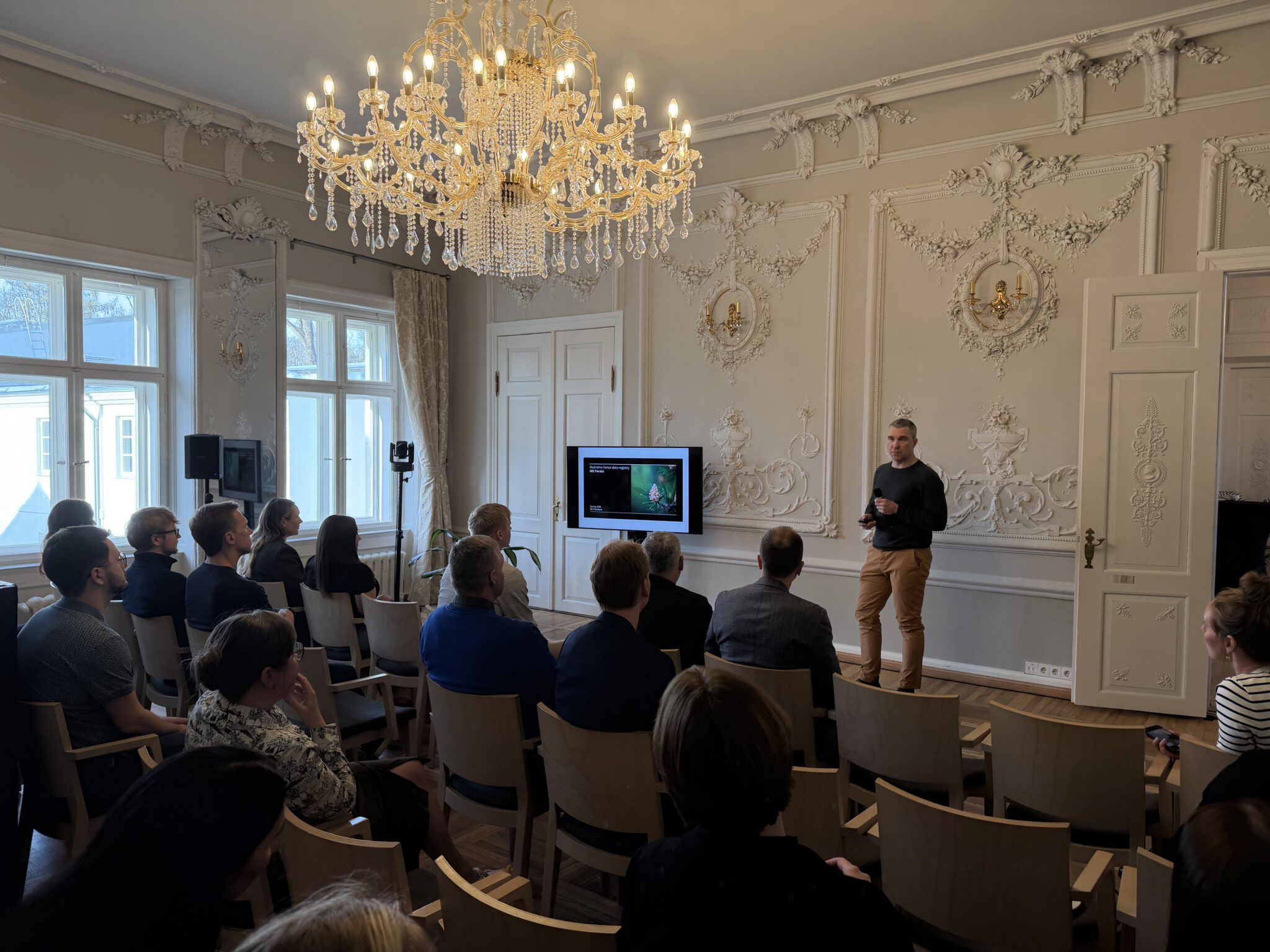
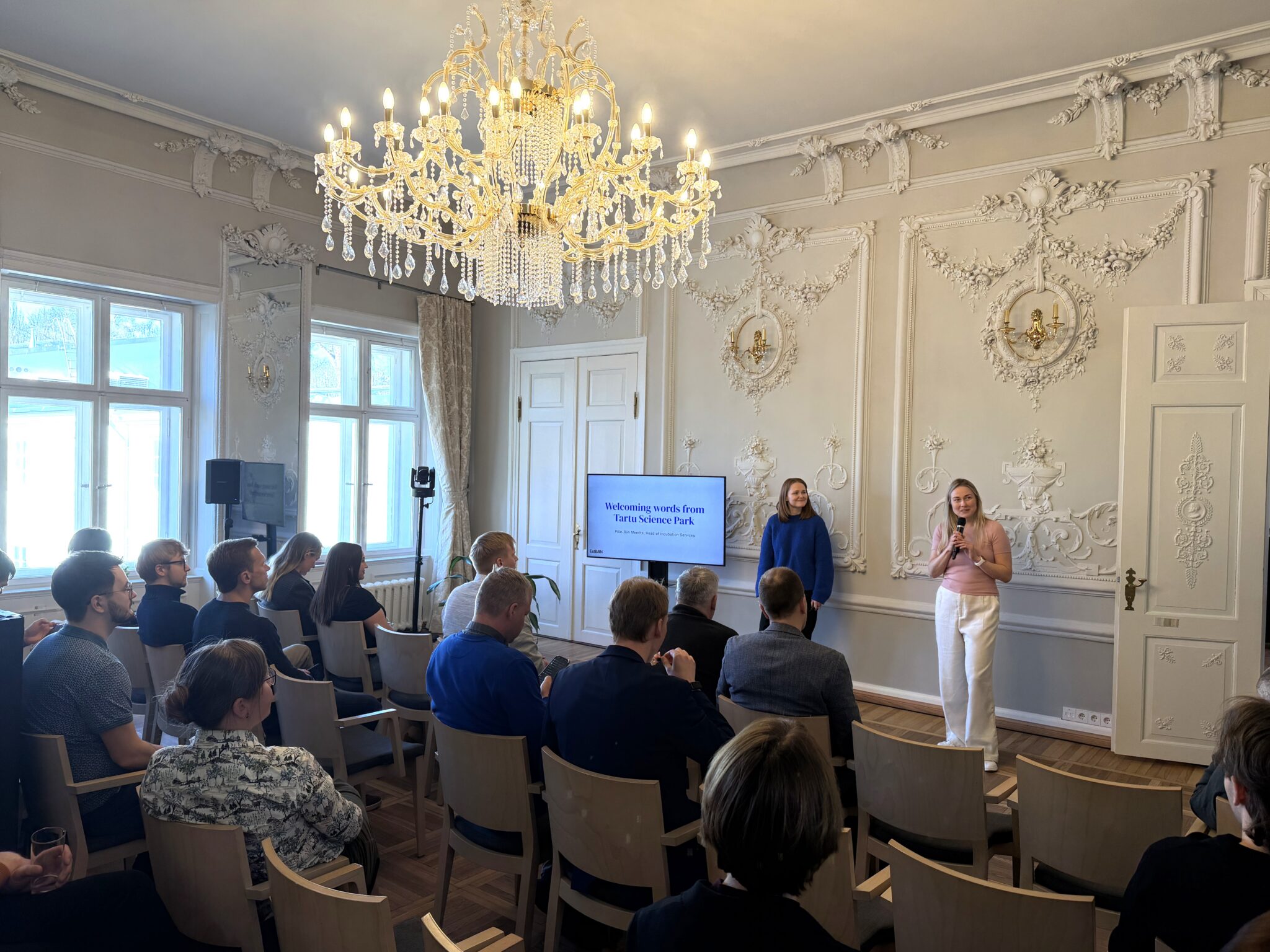
On April 23, the annual pitch event organized in collaboration between EstBAN and Sparkup Tartu Science Park took place, featuring five early-stage startups presenting on stage. The event brought together investors, founders, and ecosystem representatives from Tartu, offering a strong overview of the complex and science-intensive problems currently being tackled in the region.
The evening began with arrival and opening remarks, followed by a keynote presentation and then the startup pitching session. After the presentations, participants stayed to network and continue discussions.
From space to defense technology: the journey of CrystalSpace
The keynote was delivered by Pätris Halapuu from CrystalSpace, who shared a practical perspective on building a deep tech company. He spoke about how CrystalSpace grew out of a student satellite project and has since reached an international level, developing camera systems for both the space and defense industries.
A central theme of the talk was finding and maintaining focus. In the early years, the team experimented with multiple directions but ultimately chose to concentrate on one clear product. This allowed them to build strong expertise and a reliable solution, which is critical in this field. He also emphasized that in deep tech, a good idea alone is not enough. What matters is a working, tested, and validated product.
Beyond technology, he highlighted the challenges on the business and sales side, where deals can take months or even years. This means that in addition to engineers, teams also need people capable of bringing the product to market.
Following the keynote, five startups took the stage to present their solutions to investors. These were early-stage teams seeking capital and strategic partners to take their technologies to the next level. The pitches were short and focused, covering the problem, solution, market, and next steps.
Cata Strato addresses the cost imbalance in counter-drone systems
Cata Strato focused on the imbalance between low-cost drones and expensive air defense systems. Their goal is to develop a cost-efficient counter-drone solution that enables protection of critical infrastructure at a significantly lower cost than current alternatives.
Their approach is based on capture devices with different ranges, forming a layered defense system. The focus is on simple design and accessible components to ensure fast and scalable production. In addition, they are developing a vision system that has already attracted interest in civilian applications, such as drone detection.
Flaperon makes LiDAR technology more accessible
Flaperon is developing a drone-based LiDAR solution aimed at making high-precision spatial data collection significantly more affordable. Their background in powerline inspection showed that many tasks can be performed with simpler and more cost-effective tools than those typically used in the market.
Their system can be used for powerline inspections, forestry, and other applications requiring accurate mapping of terrain and objects. The current focus is on bringing the solution to production readiness.
EsaDres brings personalized treatment to wound care
EsaDres addressed a key challenge in healthcare, where different patients and wounds require different approaches. The company is developing a solution that enables the production of personalized wound dressings directly in clinical settings.
The technology is based on antimicrobial peptides that help control infection and accelerate healing. The solution is already in the pilot phase, and collaboration with clinical partners enables progress toward clinical trials and market entry.
MS Forest digitizes decision-making in forestry
MS Forest focuses on one of the biggest challenges in forestry: the lack of up-to-date and accurate data. The company uses satellite and remote sensing data to provide forest owners with real-time insights into forest conditions.
This enables better decision-making, more accurate valuation, and more efficient planning of activities. The solution is already in use with partners, and the company plans to expand internationally. The main challenge currently lies in technological limitations related to precise tree species identification.
Ormia introduces a new approach to drone detection
Ormia is developing acoustic sensors that enable drone detection based on sound. This addresses a key limitation of conventional sensors, which often struggle to detect low-flying or autonomous drones.
The solution is primarily aimed at protecting critical infrastructure, and the company is actively moving toward pilot projects in collaboration with ports, prisons, and defense sector organizations.
The EstBAN x Tartu Science Park pitch event clearly demonstrated that Estonia’s deep tech ecosystem is both diverse and ambitious. The startups on stage are tackling complex, systemic challenges and developing technologies with strong potential for international growth.