
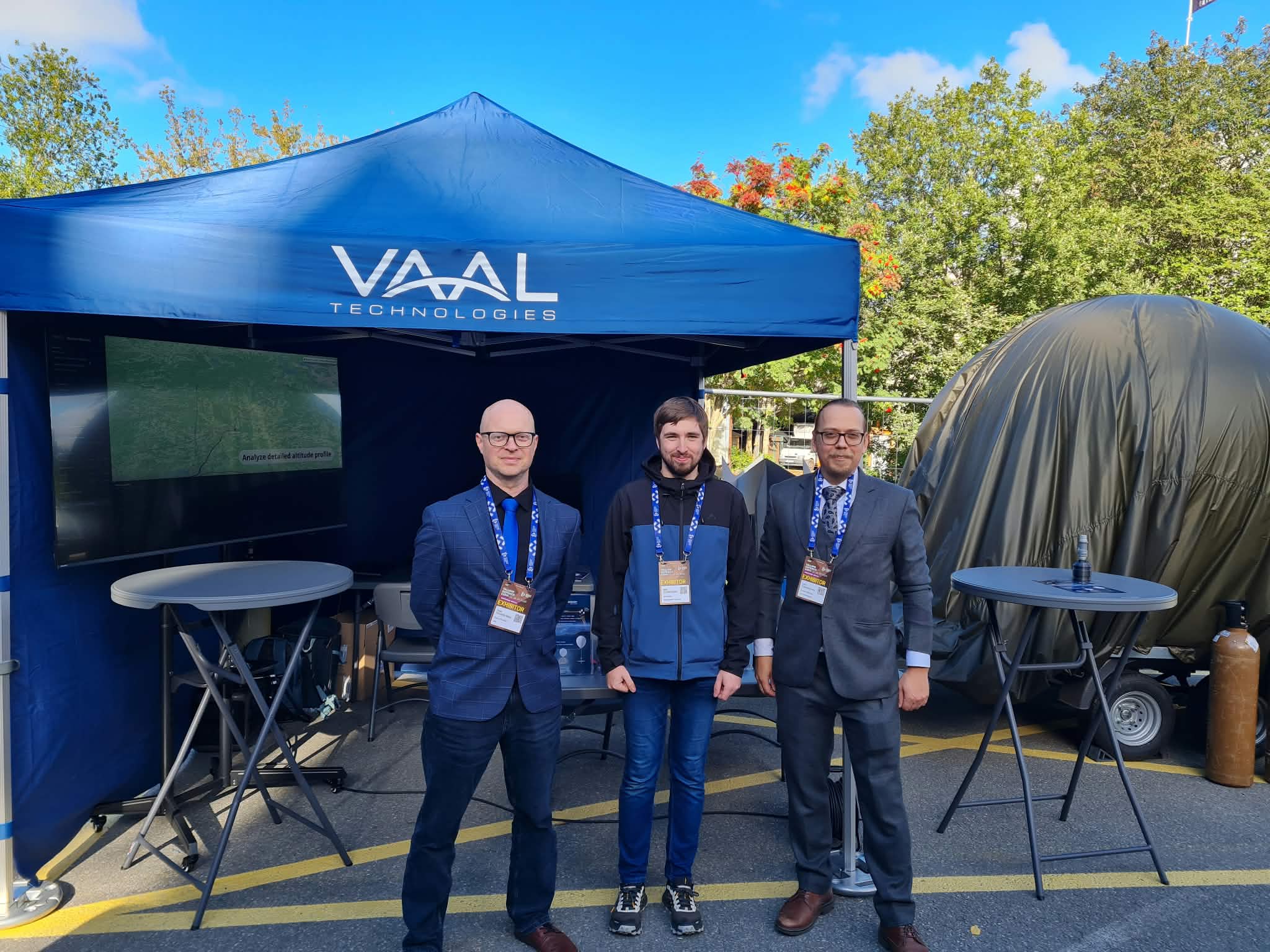
VAAL Technologies completed the program in August 2026. We caught up with them to find out how things have gone since then and talked with one of the founders, Rauno Gordon (pictured left), about their time in the program.
What problem were you trying to solve when you founded the company, and who are your clients today?
We started by making stratospheric balloons for free-fall testing. Since then, we’ve shifted more toward the defense sector, as this represents a concrete application: carrying drones over long distances. We have now shifted our focus away from the falling object and are concentrating more on balloons and predicting flight success. We found an application that is slightly simpler than our original ambition, but which offers a larger business model and the potential to scale for greater revenue. Demand is currently highest in Ukraine.
What prompted you to apply to ESA BIC?
For a startup, funding is always the most important thing, and that was the main draw. Many people start with a technological idea, but not necessarily a business idea. This program pushes you to focus more on developing a business model -though there could have been even more emphasis on that.
What was the most valuable thing you gained during the program – whether it was a contact, advice, or access to infrastructure?
The training sessions were spot on; I believe all startups really need more guidance in areas like marketing, business strategy, investor readiness and law, so that they consider these aspects as well. Looking back, I realize we didn’t get enough of this. I definitely recommend participating in these training sessions and taking them very seriously. You need to understand what an investor wants and what they care about; they aren’t interested in the technical side — they care about who the customers are. Someone needs to drill this into you; a startup won’t figure it out on its own.
During the incubation period, you need to find co-founders to fill gaps in your team — specifically business-oriented people, legal experts, and so on.
How do you view the role of balloons alongside satellites and high-altitude aircrafts? Are they competitors, or do they complement each other?
In a sense, we don’t compete with drones. We offer smaller drones a greater operational range. Since smaller drones often compete with larger ones, we give the smaller ones the ability to reach further distances.
Surveillance drones — we offer them the chance to go further, too. While they do compete to some extent with satellite surveillance, they are still sufficiently different.
We transport the drone to its destination, leaving it with twice as much energy for the return flight.
Where do you see the company in two to three years?
We believe that our current business model and concept will take off, so we won’t need to pivot again. In a couple of years, we should have revenue and clients—likely a turnover in the millions, supported by investors.
How have you yourself changed as a leader?
I have learned a great deal. I have become much more commercially aware. I’ve learned about the field and come to realize that if I’m not personally good at something, I need to find someone who is.
If you could send any payload into the stratosphere, what would it be?
Personally, I’m really interested in microgravity; we could send something as high as possible, allowing for about 20 seconds of freefall.
Alternatively, something focused on visuals — if the conditions are perfectly clear, it would be amazing to fly a probe over Estonia and capture the scenery. Right now, though, that’s held up by flight safety regulations and legislation.
Any last comments?
We welcome everyone to test with us. It’s still a bit too early for microgravity—mainly due to legislation and permits—but we can launch payloads into the stratosphere, for marketing purposes for example.
