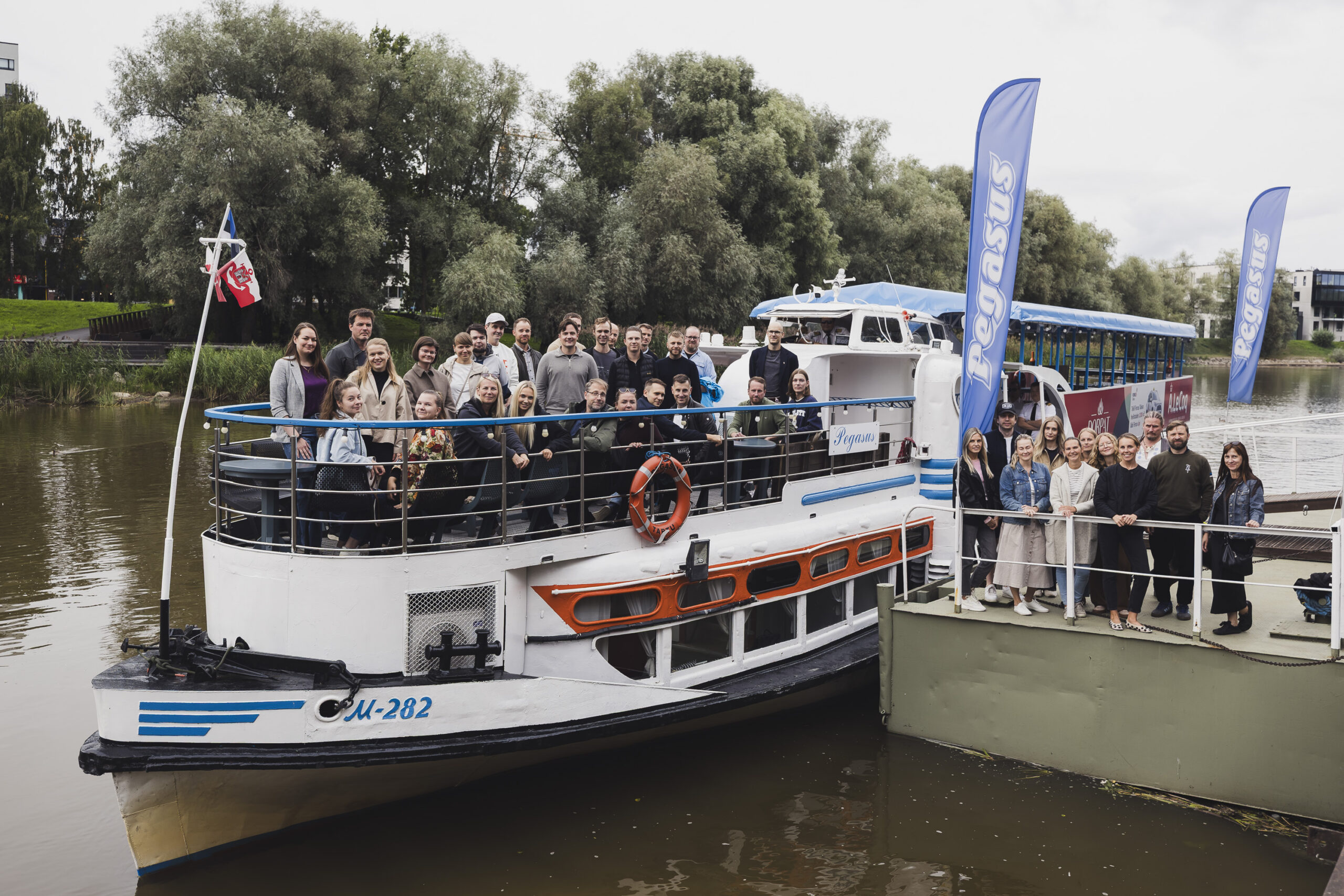
On 18–19 August, founders from the first cohort of the DeepTech Accelerator met in Tartu to tackle a question critical for any growing company: how do you build a team that helps the company move forward, without the team itself becoming an obstacle to growth?
The two-day training focused on team architecture, how to tie together company strategy, the capabilities needed, roles, people, and the collaboration between them into a coherent whole. After the first training day, a boat trip on the Emajõgi River gave participants a chance to continue discussing what they’d learned in a more relaxed setting, make new connections, and learn from one another.
The day was opened by Pille-Riin Meerits, head of incubation services at Sparkup Tartu Science Park, Kristiina Libe, deep tech project manager at Tehnopol, and Liisi Kirch, head of the startup sector at the Ministry of Economic Affairs and Communications.
Growth doesn’t mean the founder has to do more
The training quickly arrived at a simple but sometimes uncomfortable question for founders: What should I stop doing in the next 12 months?
According to Endel Hango, a trainer at Change Consulting, this was one of the day’s key takeaways.
What resonated most with DeepTech Accelerator founders during the training was a simple idea: as companies grow, founders don’t need to do more; they need to make increasingly deliberate decisions about who does what, what capabilities the team needs, and what they themselves need to let go of. Good team architecture ties together strategy, capabilities, roles, people, and collaboration. And sometimes the most important question isn’t ‘who do we need to hire?’ but ‘what should I stop doing in the next 12 months?'”
One of the companies that took part was CogniFlow, whose co-founder, Tamas Pardy, said the workshop helped them articulate and structure team principles that had until then been developed mostly intuitively.
“The CogniFlow team had worked together for years before founding the company, and within our group we had intuitively developed an informal code of conduct. We already sensed that it wouldn’t translate well into a business context, and Endel’s workshop confirmed that. It gave us the tools and knowledge to start building a team framework that can scale from an early stage. At the same time, we got concrete advice we could apply right away, for example on meeting frequency, structure and purpose, and defining core principles, roles, and the collaboration between them. These will help us improve efficiency in a business context and fill the roles we’re missing.”
This perspective encouraged participants to look at their teams with fresh eyes. The focus wasn’t just on hiring the next person, but on which roles and responsibilities the company actually needs in its next growth phase, and what a founder can hand off to others.
The two-day training moved logically from understanding the current situation to concrete action. On the first day, participants mapped out the company strategy along with the team’s needed capabilities and roles. The second day focused on filling missing roles and successfully onboarding new team members.
A useful framework and new perspectives
Participants’ feedback showed that the training topic was highly relevant for founders. Especially valuable was the opportunity to think more clearly about their team’s roles and responsibilities than before, and to see a complete framework for building a team in a growing company.
Shared training days offer, alongside new knowledge, a chance to compare experiences with other founders. For deep tech companies, which often need to build a team quickly in a highly specialized, fast-changing field, learning from each other’s experience is especially valuable.


The day continued on the Emajõgi River
After a substantive day of training, conversations continued on the Emajõgi River. A shared boat trip offered a chance to wind down the day, share thoughts and experiences, and deepen connections among participants.
The DeepTech Accelerator program continues with further training sessions and joint events supporting companies at various stages of development. The next focus area is problem validation.
The DeepTech Accelerator is part of the Deep Tech Startup Network. The network was established to consolidate and strengthen existing efforts through which the state is investing over 12 million euros in deep tech, supporting the growth of companies emerging from research. The goal is to bring researchers and entrepreneurs together to accelerate the path from science-based solutions into business, grow strong deep tech startups, and create high-tech, sustainable jobs.
Through public investment, the network also creates the conditions for greater private capital involvement in later development stages, strengthening the overall development of Estonia’s deep tech startup ecosystem. The Deep Tech Startup Network is funded by the Ministry of Economic Affairs and Communications.